There was an untitled piece by Man Ray that I really liked. A drawing of a shirt placed over the bust of a wire mannequin inside what looked like a clothier's shop.
I like the Whitney, but it looks like they're driving one of my favorite bookstores out of business once and for all. Books & Co., a few doors down from the museum, is closing up on May 31st. Books & Co., is one of the only places in town where I feel comfortable exerting hours worth of inertia sitting in one spot doing absolutely nothing. Which is not to say that I spent a lot of time there. I did not. But it owns a calming environment which none of the other bookstores around here possess.
The store blames the Whitney and the internet book-buying and Barnes & Noble for this situation, but it's hard not to think that they could have done something to try and compete with what is nothing more than reality. Smaller bookstores are shutting down all over the place, and I've started to notice that thrift shops and second-hand stores are starting to assume the inventories of used bookstores as they also disappear from the city.
Wandering around this afternoon, I passed a thrift store on 2nd Avenue near 88th Street. I've been in there many times, but it never fails to seal the feeling of disconnect between my daily life and the past I feel opening up behind me. Going into this particular shop, they have hundreds of classical LP records and 8-track cassettes. Thousands of ratty shirts, shelf after shelf of board games, bread boxes, yogurt makers, mysterious electronics devices from the 70's.
The classical LPs own a particular resonance for me. When I was growing up, we had a modest collection of classical LPs. Rubinstein, Serkin, Chopin, Brahms. Mostly standard repertoire, though never any Horowitz. For years I head this idea that Horowitz recordings were too extreme for decent folk. I also had this idea that they were just too expensive, perhaps owing to my standard of buying classical LPs from the dollar-bin at record stores.
I have come to think that many of Horowitz's recordings are vulgar and even obscene, but they always come from the highest levels of individuality and accomplishment which no one has any right to criticize.
But when I was 10 or 11, it was impossible to imagine anything more boring than Brahms' 2nd Piano Concerto. And it was impossible to imagine anything as arch an experience as hearing Rudolf Serkin and Eugene Ormandy's performance of that piece on LP. Listening to it was agony, but I listened to it time after time after time.
I was torturing myself, thinking that doing this would make me a stronger person, a smarter boy, a more tolerant and worldly individual. If I could understand and appreciate that vastly blank piece of music, I could understand anything.
To make this self-flagellation even more brutal, I frequently tried to read the works of Sophocles. And Euripides. George Bernard Shaw. Shakespeare, of course. Plato, Tolstoy, Dostoyevsky, Thomas Wolfe, more Shaw, endless volumes of old poetry, Sartre, Greek Mythology. All of it poured over me like a hot, foggy night, with only particles of comprehension glimmering in the heady maelstrom of all this "Western Thought" I wanted so much to absorb.
Not all of it washed away. Shaw's last play, Why She Would Not, is a piece of work which means a lot to me. I even transcribed some of it last year in another vein attempt at impressing a woman.
But understanding and enrichment were not what mattered. What mattered to me was simply assuming the posture of intellectualism which might allow me to magically open thousand-page tomes and point directly to that quote which forever changed our culture. (I don't know what that quote is; in fact, it's purely hypothetical) What mattered was that I had memorized quotes from Shakespeare. What mattered less was that these were quotes of no significance whatsoever. What did it matter to me? The famous quotes didn't mean anything to me anyway, why not memorize alternative lines? And isn't it ALL great, anyway?
Most of this perusing was accompanied by the heaving, tortuous pomposity of Johannes Brahms' Second Piano Concerto, a work I forever associate with starchy ivory tower pursuits of intellectual and cultural conquest devoid of any real feelings for thought or music or art.
But don't misunderstand this. I love Brahms, and find his life to be a compelling example of how much good and meaningful work you can accomplish if you never get married.
In 1993, there were several months in which I looked forward to waking up every day so I could get to work and play my tape of his Händel Variations again and again and again. And I am absolutely intolerant of bad performances of his 4 Symphonies (I've walked out of many performances of these works), although come to think of it, I don't really know his 3rd very well.
I realized many years later, after I moved to New York, that I never outgrew this habit of trying to comprehend things which were incomprehensible to me. I'm not sure when it happened, but it may have been the day I found myself reading the Manhattan White Pages as if that giant volume of names was just a magazine.
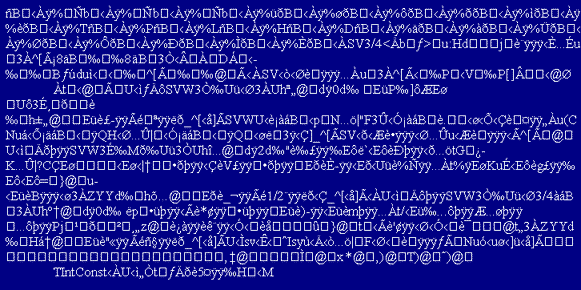
Or maybe it was the day I visited a friend in Philadelphia and turned on his computer and started browsing binary-executable files using a word processor. You know what that's like right? Stuff comes up like this: